1000 Hives · Biosecurity & Beekeeping
Why we do not move our hives. Ever.
Most commercial beekeeping is built around movement.
We built ours around the opposite.
In a Varroa-positive country, that matters more than ever.
No cross-contamination
Every August, over 200,000 Australian beehives get loaded onto trucks. They travel from Tasmania, Victoria, NSW, and South Australia toward the almond groves of the Sunraysia and Riverland regions. By mid-August they are packed into orchards, parked in unfamiliar country, doing the work they were hired to do.
Then it starts again. Canola season. Citrus. Native bush. Lucerne. The hives spend half their year on the road, following the bloom like contractors chasing the next job. It is called migratory beekeeping, and it is the dominant model in Australian commercial pollination. Around 2,000 commercial operators, roughly 4% of all registered beekeepers, manage 80% of the country's honey production this way. Some move their hives up to 20 times in a single year.
It is also a model built for a world that no longer exists. A world without Varroa.
The hidden cost of movement
Trucking hives is not gentle. Colonies get shaken, disoriented, and stressed. Bees that were foraging familiar territory at dusk wake up in a completely different landscape. Research from the United States has shown that migratory bees have measurably shorter lifespans than stationary bees, with the stress of transport compounding other pressures like nutritional deficits and chemical exposure. On a worker bee that lives roughly six weeks during foraging season, even a small reduction in lifespan means fewer foraging days per bee and weaker colonies overall.
Stress also suppresses immune function. A stressed colony fights disease less effectively, tolerates parasites less well, and recovers from setbacks more slowly. When you are moving hives between dozens of different apiaries across multiple states every few weeks, you are not just transporting bees. You are transporting pathogens, pests, and resistance genetics.
Australia's rapid Varroa spread since June 2022 has been directly linked to the migratory nature of the beekeeping industry. The mite hitchhikes on adult bees and in brood. When hives move between states for pollination contracts, the mites move with them. Emergency movement restrictions during the initial response slowed the spread, but once those restrictions lifted, the mite followed the trucks. Victoria confirmed its first detection in August 2024, near Mildura, a region that receives thousands of migratory hives every almond season. Queensland followed in March 2025. South Australia in September 2025.
The pattern is not a coincidence.
Varroa has spread along the same routes that migratory beekeepers travel. The biosecurity risk of hive movement was well understood before June 2022. It is now a documented reality. Every unnecessary hive movement in a Varroa-positive country increases the probability of spreading mites, spreading resistance genetics, and overwhelming the treatment systems of beekeepers in the destination region.
No relationship with the land
Beyond biosecurity, the migratory model has a structural problem that rarely gets discussed. There is no relationship between the hive and the land it visits.
A colony arrives at an almond orchard for six weeks. It pollinates, it leaves. Next season, different hives from a different beekeeper go to the same orchard. The farmer has no relationship with the bees or the beekeeper. The beekeeper has no knowledge of that specific property, its microclimates, its flowering patterns, its water sources, its pest pressures.
Nobody learns anything. Nobody builds anything. The hive is a hired hand, and the arrangement ends when the bloom does.
For the farmer, this means unreliable pollination. Some years the hives arrive healthy and strong. Some years they arrive stressed, depleted from the last contract, and underperform. The farmer has no control over quality and limited ability to hold anyone accountable. They are buying a commodity service with no continuity.
A model built for a world without Varroa
The migratory model made sense in a specific economic moment. Land access was cheap. Fuel was affordable. Labour was available. One beekeeper with a truck and 500 hives could follow peak bloom across the country, chasing honey flows and picking up pollination contracts along the way. The economics worked because the inputs were cheap and the system was forgiving.
That system is under pressure from every direction. Fuel costs have risen. Skilled labour is harder to find. Land access for apiary sites is increasingly competitive. And Varroa has added an entirely new layer of cost and complexity. Treatment chemicals, monitoring equipment, record-keeping systems, resistance testing. All of this costs money and time that the migratory model's margins were never designed to absorb.
The result is an industry being squeezed. Older operators are retiring without replacement. Younger beekeepers look at the economics and the lifestyle, months on the road, hives on trucks, constant movement, and choose something else. The workforce is shrinking at exactly the moment Varroa demands it should be growing.
Pyrethroid resistance makes this worse.
Confirmed in NSW in January 2026 and Queensland in February 2026, pyrethroid resistance means beekeepers can no longer rely on the cheapest and simplest treatment option. Migratory operations that move hives between regions risk carrying resistant mite populations into areas that were previously manageable. The resistance follows the trucks, just like the mites do.
What embedded beekeeping looks like
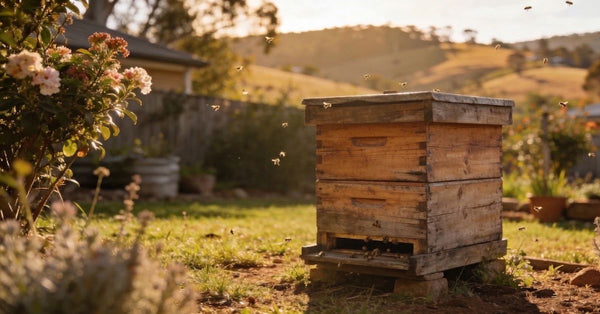
Permanent hives stay on one farm, year-round. They winter there. They build up in spring for local fruit blossom. They forage summer natives and autumn pasture. The colony that pollinates your orchard in October is the same one that was there in February. It learns the land. The bees know where the water is, where the best forage grows, and how to navigate the property without the disorientation of waking up somewhere new.
The stress factor drops substantially. No truck. No relocation. No sudden change of landscape. Bees stay in their home territory, building the kind of colony strength and resilience that migratory operations can never replicate. Healthier bees live longer, forage more effectively, and produce stronger brood cycles.
Migratory model
Hives moved up to 20 times per year
Different beekeeper, different hives each season
No continuity of care on any one property
Transport stress weakens colonies
Every movement spreads biosecurity risk
Beekeeper manages by apiary code, not by name
Embedded model
Hives placed once, permanently
Same beekeeper, same hives, same farm
Year-round relationship with the land
Zero transport stress on colonies
No movement means no biosecurity risk from transport
Beekeeper knows every hive individually
Pest and disease management becomes consistent. The same beekeeper visits the same hives on a regular schedule. They know every colony. They spot problems early, before a mite load becomes a crisis or a weak queen becomes a failing hive. They build actual knowledge about that specific property over time, knowledge that compounds season after season.
The local ecosystem gets year-round pollination from the same colony. More reliable fruit set. More consistent yields. A hive that becomes part of the farm infrastructure, not a hired service passing through.
Why we chose permanent placement
We chose the embedded model because it is better for bees, better for farmers, and better for the land. But there is a harder reason too.
In a Varroa-positive country, every hive movement is a biosecurity decision. We made ours. Our hives do not move. Once placed on a farm, they stay. The colony that arrives is the colony that stays, through every season, every treatment cycle, every inspection.
Every 1000 Hives beekeeper visits one property per day. Not a cluster of properties. One farm. That is a deliberate biosecurity commitment with a real cost to operational efficiency, and we accept that cost because in a Varroa-positive country it is the only responsible way to run a professional network.
One farm. One beekeeper. One set of hives. Every visit.
This means no cross-contamination between properties. No mites hitchhiking from one farm to the next on a beekeeper's equipment. No resistant genetics carried in brood from one region to another. The biosecurity benefit is not theoretical. It is built into every operational decision we make.
Embedded hives are accountable. They are inspected regularly, documented properly, and managed by someone who knows them individually. That kind of attention is what keeps colonies healthy through Varroa pressure. It is also what makes this a real conservation model and not just a conservation story.
The shift ahead
Migratory beekeeping will persist for high-value, high-density crops where the economics still justify it. Almonds in particular will continue to require mass temporary pollination because no single region has enough permanent hives to service the bloom. That reality is not changing soon.
But migratory beekeeping is not the future of Australian pollination as a whole. The disease pressure is too high, the margins too thin, the workforce too stretched, and too many farms need something migratory hives cannot offer. Consistency. Accountability. A colony that belongs to the property and a beekeeper who knows the land.
The future is hundreds of permanent apiaries scattered across working farms, each one managed by someone who knows it inside out, supporting year-round agricultural productivity and ecosystem health at the same time. Not a service that arrives once and leaves. Infrastructure that stays.