1000 Hives · The Model
Why farmers do not buy their own hives
It seems obvious.
If a farm benefits from pollination, why not just buy bees?
The answer is why 1000 Hives exists.
Spend a few hundred dollars, slap a hive on the back paddock, done. That is what most people picture when they think about getting bees onto a farm. It sounds simple. It is not.
The reality is that most farmers will never keep bees themselves, not because they do not care about pollination, but because the economics, the skill requirements, and the biosecurity obligations make it a terrible use of their time and money. Understanding why is the quickest way to understand what 1000 Hives actually does and why the model works.
The money does not stack up
Australian farming runs on thin margins. A grain farmer might clear 15 to 20 percent on a good year. A sheep operation runs at single digits. Capital equipment is expensive, feed costs are volatile, and labour is hard to find.
A farmer looking at beekeeping does not see a simple $400 hive purchase. They see a stack of costs that add up fast and come with zero guarantee of return.
Hive and frames
A complete hive setup with brood box, super, frames, and base. This is the starting point, not the finish line.
Package of bees or nucleus colony
A nucleus colony with a mated queen and established brood. Without this, the hive is just an empty box.
Feed and supplements
Sugar syrup, pollen patties, and supplements to get a colony established and through lean periods.
Varroa treatments
Monitoring equipment, organic acids, synthetic acaricides. Non-negotiable and ongoing.
Tools and protective gear
Bee suit, smoker, hive tool, gloves, uncapping knife, and other essentials. You need all of it from day one.
Colony replacement
If the colony fails to Varroa or disease, you start again. Another nuc, another $300. Most beginners lose their first colony.
That is north of $1,500 before the bees have produced a single thing. And that is the optimistic scenario where nothing goes wrong on the first attempt. Most things go wrong on the first attempt.
Beekeeping is not a weekend hobby
Farmers are good at farming. They are not beekeepers, and beekeeping is not something you pick up from a YouTube video and a sunny afternoon.
A healthy hive requires inspections every four to six weeks during the active season. It requires the ability to identify diseases like foulbrood, nosema, and chalk brood before they destroy the colony. It requires Varroa monitoring, treatment timing, and rotation of treatments to avoid resistance building. It requires nutritional assessment, knowing when a hive needs feeding and what to feed. It requires genetic selection, understanding which colonies to propagate and which to replace. And it requires proper record-keeping and documentation.
This is a skilled trade. A farmer picking up a hive without training will, statistically, lose the colony within 18 months. Not because they are incompetent. Because beekeeping is a discipline that takes years to learn properly.
Varroa changes everything
Varroa destructor was first detected in Australia in June 2022 at the Port of Newcastle. Despite an intensive eradication effort, the mite has now spread across multiple states. It is here to stay.
Without monitoring and treatment, a hive will collapse to Varroa within 12 to 18 months. The bees will not just underperform. They will die.
Managing Varroa is not optional.
It means learning to identify infestation levels through alcohol washes, sugar shakes, and sticky board monitoring. It means understanding treatment options across organic acids, synthetic acaricides, and integrated pest management. It means knowing when to intervene, rotating treatments to prevent resistance, and recording everything. A farmer without beekeeping knowledge will not manage this. So they will not try.
How we solve this
1000 Hives flips the problem around. The farmer contributes land and access. That is all. Zero capital, zero labour, zero expertise required. In return, they get full-time pollination from a managed, healthy hive.
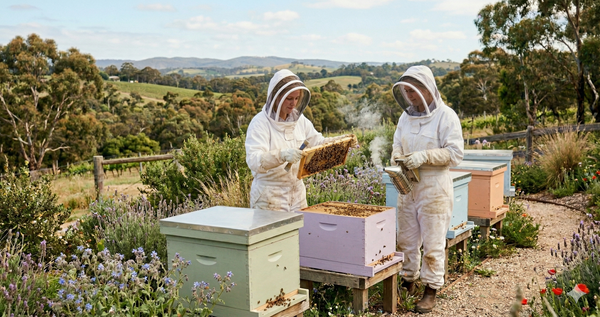
The beekeeper gets paid a proper income to be a beekeeper. They bring the skill, the equipment, the time, the biosecurity compliance, and the discipline. This is their livelihood, so they get it right.
The sponsor funds it because they believe in the value of the work. Their money is not lost to a farmer's failed experiment. It is deployed by someone who knows what they are doing, on a farm that needs pollination.
High risk, low success
$1,500+ upfront with no guaranteed return. Colony losses likely within 18 months without professional knowledge. Varroa management alone is a part-time job. The farmer already has a full-time one.
Low risk, professional pollination
No capital outlay for the farmer. Professional beekeeper manages the hive permanently on site. Varroa treated, diseases monitored, biosecurity maintained. Everyone plays their position.
When DIY fails
Say a farmer does try. They buy a hive for $500, a nuc for $300, feed for $300, and gear for $300. Year one, they lose the colony to Varroa because they missed a treatment window. That is $1,400 gone. They buy another nuc and more feed. Another loss. By the time they quit, usually by year two, they have spent over $2,000 on dead bees.
A professional beekeeper operating at scale across five, ten, or twenty sites spreads their knowledge and labour across multiple hives. They spot Varroa problems early. They intervene decisively. They succeed because they are doing one job, and they are good at it.
That is what a sponsorship pays for. That is what works.
Farmers are not lazy. They are rational.
A farmer will invest time and capital in something they are good at. That is usually farming. They partner with specialists for everything else. Vets, agronomists, mechanics, shearers. Because specialists deliver better results than amateurs.
Beekeeping is no different. A professional beekeeper will deliver healthier colonies, better pollination outcomes, and Varroa management that actually works. A farmer without expertise will end up with neither bees nor pollination, just frustration and wasted money.
Sponsoring a hive through 1000 Hives costs the farmer nothing. Zero capital. Zero labour. Zero risk. Guaranteed pollination from a professional who does this for a living. That is not a hard choice. That is the smart one.