1000 Hives · Native Bees & Conservation
We care about native bees too
Australia has over 2,000 species of native bees. Most people have never seen one. Here is what is actually threatening them, and what we are doing about it.
Australia is home to more than 2,000 species of native bees. Most of them are solitary. Most do not make honey. Most are not yellow and black. And most Australians have never knowingly seen one.
1000 Hives exists because Australian agriculture has a pollination crisis. Managed European honey bees on working farms are how we address it. Food security is the reason we started, and it remains the core of what we do.
But we have not forgotten native bees. We think about them a lot, actually. Every property in our network includes native habitat support through our Beyond the Hive initiative, because native flowering plants are what native bees evolved to use. We think anyone who cares about bees should care about all of them, and that starts with understanding what Australia's native species actually face.
Meet the locals
These species have been here for tens of millions of years, long before the first European honey bee arrived in 1822. They are extraordinarily diverse in size, behaviour, nesting habit, and ecological role. Some are specialists, adapted to pollinate a single genus of plant and found nowhere else on earth. Others are generalists that visit hundreds of flower species across their range.
Blue-banded bee
Metallic blue stripes on a robust black body. Found across most of Australia. Uses buzz pollination, vibrating at a specific frequency to release pollen that honey bees cannot access. Superior pollinator for tomatoes, blueberries, and eggplants.
Stingless bees
Eleven species across two genera, Tetragonula and Austroplebeia. The only truly social native bees in Australia. Build elaborate resin nests inside tree hollows. Produce small quantities of tangy, complex honey. Found mainly in tropical and subtropical regions.
Green carpenter bee
Glossy metallic green body up to 24mm long. Nests in the flower stalks of grass trees. Once found across southeastern Australia, now locally extinct in Victoria and mainland South Australia due to habitat loss. A conservation concern.
Teddy bear bee
Densely furred, rotund, and ginger-coloured. Nests in soil. One of the most frequently observed native bees in southeastern Australia and one of the easiest to attract to gardens with the right plantings.
The vast majority of Australia's native bees are solitary. A female digs a burrow in soil, collects pollen and nectar, provisions a brood cell, lays an egg, seals it, and moves on. There is no queen, no workers, no hive. Just individual female bees doing everything themselves. That solitary lifestyle makes them fundamentally different to honey bees in almost every way that matters ecologically.
Why native bees matter
Native bees are the original pollinators of Australia's flora. Our native plants evolved over millions of years in relationship with native bee species, not with European honey bees. Many native plant species have highly specific pollination requirements that only native bees can meet.
Buzz pollination is one of the most important examples. Many Australian plants, including species from the Solanum family, store pollen inside tube-like anthers that only release it when vibrated at a specific frequency. Blue-banded bees, teddy bear bees, and several other native species do this naturally. European honey bees cannot produce sonication and cannot access that pollen at all. For those plants, native bees are not just helpful. They are irreplaceable.
Beyond specific plant relationships, native bees support the broader web of native ecosystems. Native plants pollinated by native bees produce seeds and fruit that feed birds, reptiles, and mammals. The loss of native bee populations creates cascading effects through ecosystems that are difficult to predict and very difficult to reverse.
What threatens native bees
If you care about native bees, it is worth understanding what the evidence actually says about what is driving their decline. The threats are real and well-documented, and different threats need different responses.
Habitat loss is the big one. Most native bees nest in the ground or in dead timber. Land clearing for agriculture, urban development, and infrastructure removes nesting habitat at scale. Intensified farming reduces floral diversity in agricultural landscapes, leaving native bees without sufficient pollen and nectar resources across the seasons. This is the single largest threat and it operates at a scale that dwarfs any other factor.
Pesticide exposure is the second most significant documented threat.
Systemic insecticides, particularly neonicotinoids, affect bee navigation, memory, and reproduction even at sub-lethal doses. Native bees, being solitary and unable to buffer losses the way a honey bee colony can, are particularly vulnerable. A single female who cannot find her way back to her nest loses everything she has invested in that brood cycle. Every property in the 1000 Hives network operates under a zero tolerance pesticide policy. No insecticides, herbicides, or chemical sprays on any partner property.
Introduced species create several overlapping pressures. Feral European honey bee colonies, established in native bushland since the 1820s, compete with native bees for both floral resources and tree hollows. Studies have found high honey bee densities associated with reduced native bee abundance at some sites, and with skewed sex ratios in some cavity-nesting native species, where competition for food forces mother bees to produce more male offspring. The long-term population implications of this are not yet fully understood but the concern is credible.
Other introduced species add to the pressure. The South African carder bee, first detected near Brisbane in 2000, has spread through eastern Australia and competes with native bees for nest sites. The European bumblebee, accidentally introduced to Tasmania in 1992, is an aggressive competitor that has spread across the island and poses a mainland invasion risk.
The feral honey bee question
Feral European honey bee colonies occupy tree hollows in Australian bushland at high densities. Research in Western Australia has recorded up to 218 feral colonies in a single kilometre of creek line. These hollows take between 100 and 150 years to form in eucalypt trees. Once a honey bee colony occupies one, it is unavailable to native hollow-dependent species including native bees, birds, possums, and bats for years or decades.
Competition for floral resources is harder to quantify but also documented. Honey bees are highly efficient foragers with large colony sizes, long foraging ranges, and the ability to recruit workers rapidly to productive food sources. In areas of high honey bee density, native bees may find food resources depleted, particularly during periods of low floral abundance.
Feral colonies in bushland
Unmanaged feral colonies in native bushland compete for hollows and floral resources at potentially damaging densities. The NSW government lists competition from feral honey bees as a key threatening process under conservation legislation.
Managed hives on farmland
Managed hives on agricultural land operate in a fundamentally different ecological context. They are placed on farmland to pollinate crops, not in native bushland. Their impact on native bee populations in those landscapes is a separate and more nuanced question.
The scientific literature on honey bee and native bee competition is mixed and context-dependent. Some studies find significant negative associations. Others find no significant effect. Researchers consistently call for more long-term, large-scale studies before firm conclusions can be drawn across all contexts. What is clear is that feral colony density in intact native bushland is a legitimate conservation concern, and one the Australian government has formally recognised.
What Varroa means for this picture
Varroa mite, now detected in five Australian states and territories, kills unmanaged honey bee colonies. That means the feral honey bee population, which has occupied Australian bushland for 200 years, is facing an unprecedented collapse. Without treatment, between 95 and 100 percent of feral colonies in temperate areas are expected to die within three to four years of Varroa infestation.
From a native bee conservation perspective, this is genuinely uncertain territory. On one hand the removal of a large, competitive introduced species from native bushland might benefit native bees by freeing up hollows and reducing competition for floral resources. On the other hand, feral honey bees have been part of Australian landscapes for 200 years and some native plant species have partly adapted around their presence. The sudden collapse of a generalist pollinator at that scale could disrupt plant pollination networks in ways that are difficult to predict.
Australian ecologists are actively researching what the collapse of feral honey bee populations will mean for native plants and native bee communities.
It is one of the most significant and least understood ecological questions facing Australian conservation right now. The honest answer is that nobody yet knows the full picture, and that uncertainty is itself a reason to invest in monitoring and research rather than assuming the outcome will be straightforwardly positive or negative.
Feral vs managed hives
This distinction matters. A feral colony in a national park hollow, competing year-round with native fauna with no management and no biosecurity, is a fundamentally different thing to a professionally managed hive placed on a working property during flowering season.
Managed beekeeping on farmland does not remove native bushland habitat. It does not occupy tree hollows. It operates in agricultural landscapes that have already been cleared and modified. The feral colony problem in native bushland is real. But ending managed beekeeping on farms does not solve it, and the evidence on managed hive impact in agricultural landscapes is considerably more mixed than the blanket claims suggest.
What we actually do
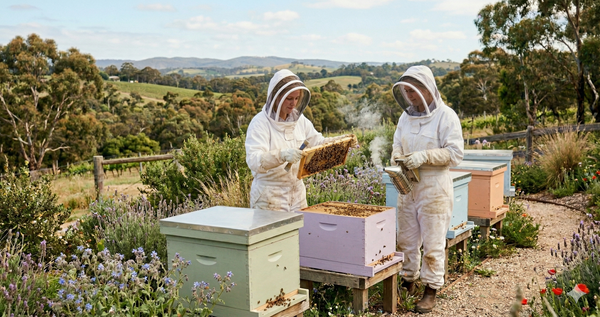
1000 Hives places professionally managed hives on farms and properties across Australia. Not in native bushland. Not in conservation areas. Every partner property is assessed for suitability and managed under documented biosecurity protocols. Our embedded model means hives stay on the property permanently under professional oversight rather than being moved between sites, which reduces disease transmission risk for all bees.
Every partner property also receives 100 native plants through our Beyond the Hive initiative. These plants are selected for the local region and planted in a dedicated habitat area on the property. They provide foraging resources for native bees, hoverflies, butterflies, and other wild pollinators well beyond the crop flowering window. A well-managed property with diverse native plantings can support productive beekeeping and a richer native bee community than degraded monoculture land. We think that is worth pursuing.
Every property in the network also operates under a zero tolerance pesticide policy. No insecticides, herbicides, or chemical sprays. That protects managed honey bees and native pollinators alike.
Our focus is agriculture and food security. That is what 1000 Hives was built for. But caring about food security and caring about native bee conservation are not opposing positions. They are different challenges in the same landscape, and we think both matter.
What actually helps native bees
If you want to do something practical for native bees, the good news is the most effective actions are well understood.
Plant native flowering species. Diversity matters as much as quantity, because different native bees have different seasonal requirements and floral preferences. A garden or property with flowering plants across spring, summer, and autumn supports a far richer native bee community than one with a single flowering flush.
Retain dead timber and undisturbed soil. The most impactful habitat interventions are often unglamorous. Leaving a section of bare ground. Keeping an old fence post. Not clearing a hollow-stemmed shrub. Native bees are adapted to find nest sites in the landscape if we let them.
Reduce pesticide use, particularly systemic insecticides applied to flowering plants. The relationship between pesticide exposure and native bee reproductive success is well established.
Support land conservation in agricultural regions. Remnant native vegetation serves as refuge habitat and seasonal food source for native bee populations in farming landscapes.
Australia's native bees are remarkable. They deserve real attention directed at the right problems. We built 1000 Hives for food security, and we are proud of that work. But we also plant 100 native species on every partner property through our Beyond the Hive initiative, because we think the bees that were here first deserve a seat at the table too.