1000 Hives · Biosecurity & Industry
Hobby beekeeping is not enough
Australia has 47,000 hobby beekeepers.
It needs 600,000 professionally managed hives.
Good intentions do not close that gap. Infrastructure does.
Hobby beekeeping is a good thing. It connects people to bees. It teaches them something real about managing livestock. Some hobby beekeepers are excellent. Disciplined, well-read, careful about biosecurity. We are not against them.
But hobby beekeeping will not save Australian agriculture. And the sooner we are honest about that, the sooner we can build what actually will.
Around 65% of Australian agricultural production depends on insect pollination, most of it delivered by honey bees. That is not a nice-to-have. It is $4.6 billion worth of crop production every year. When pollination supply falls short, crops fail, food prices rise, and export contracts go to other countries. The infrastructure that delivers pollination at that scale cannot be built on goodwill.
The numbers do not add up
Australia needs roughly 600,000 managed hives to support current agricultural production and maintain export viability. That number may need to grow as Varroa continues to wipe out wild and feral colonies that previously contributed to background pollination for free.
There are approximately 47,000 registered recreational beekeepers in Australia. That number grew sharply after 2022, partly because state governments pushed registration following the Varroa detection at the Port of Newcastle. But registration is not the same as capability. Most hobby beekeepers manage one to three hives. Many are in suburban backyards, nowhere near the farms that need pollination.
If every single one ran 10 hives perfectly, monitored and treated on schedule, permanently placed on agricultural land, that is 470,000 hives. Still short of what agriculture needs. And the assumption that all 47,000 would maintain professional-grade management, year after year, through treatment rotations, resistance monitoring, and colony losses, is not realistic. It has never happened in any country.
New Zealand proved the maths.
After Varroa established in New Zealand in the early 2000s, the hobby sector contracted sharply. Recreational beekeepers who could not keep up with treatment demands left the industry. The commercial sector absorbed the workload, but at enormous cost. Pollination fees nearly doubled from NZ$80 to over NZ$150 per hive. Some regions saw fees exceed NZ$200. The pastoral sector lost an estimated NZ$230 million a year in reduced productivity.
Hobbyists burn out. They move house. They get busy. They retire. Life happens. And when it does, the hives they leave behind become unmaintained. In a Varroa-positive country, an unmaintained hive is not just neglected. It is a biosecurity risk to every managed colony within foraging range.
Why Varroa changes the equation for hobby beekeeping
Before Varroa, hobby beekeeping in Australia was relatively low-stakes. If you forgot to inspect for a few weeks, the worst that usually happened was a swarm or a slow season. The bees mostly looked after themselves. Wild colonies filled the gaps. The system was forgiving.
Varroa changes all of that. In a Varroa-positive country, every hive requires active management. Not optional. Not seasonal. Continuous, documented, chemistry-aware management. The mite reproduces inside capped brood cells. Populations double roughly every four weeks during brood season. By the time you see visible signs, deformed wings, scattered brood, bees crawling instead of flying, the colony may already be carrying thousands of mites and spreading them to every hive within range.
What proper Varroa management actually involves
- Monitoring mite loads using alcohol wash or sugar shake, at least monthly during brood season
- Understanding which treatments to use and when, based on temperature, brood cycle, and resistance patterns in your region
- Rotating treatment chemistry so resistance does not build, which means tracking what was used and when across every hive
- Recording every inspection, every treatment, every mite count, so patterns can be identified before they become crises
- Culling colonies that cannot be saved, rather than letting them linger as mite reservoirs that infest neighbouring hives
- Coordinating with other beekeepers in the area, because Varroa management only works if everyone in a region is doing it
Some hobbyists do all of this. They are the ones who treat beekeeping as a serious responsibility, invest in training, and keep detailed records. But the research from every Varroa-affected country tells the same story. Most hobbyists do not maintain this level of discipline over time. Some do not know they should. Some know but treat Varroa like a problem they will get around to. Others refuse to treat at all, convinced they are breeding resistant bees or practising natural beekeeping.
They are not. They have a Varroa-loaded colony and a theory.
The hobbyist thinks they are being natural. The professional beekeeper five kilometres away is watching their mite loads climb, their treatment costs increase, and their production drop. And they have no recourse. There is no mechanism in most Australian states to compel a backyard beekeeper to treat their hives, even when those hives are actively undermining the biosecurity of an entire district.
The resistance problem makes this urgent
Pyrethroid resistance was confirmed in NSW in January 2026 and in Queensland the following month. Both the L925I and L925M genetic mutations have been identified. Pyrethroids were the most affordable and widely available treatment option. With resistance spreading, beekeepers now need to rotate between more expensive and more complex alternatives, including amitraz-based treatments, oxalic acid, formic acid, and thymol-based products.
Every one of those alternatives has specific application requirements. Temperature windows. Timing relative to brood cycles. Concentration thresholds. Get it wrong and you either fail to control the mites or damage the colony. Professional beekeepers with training and systems can manage this. A hobbyist who checks their hive every few weeks, if they remember, cannot.
Resistance builds faster in regions with inconsistent treatment.
When some hives in an area are treated properly and others are not, the mites that survive in untreated colonies carry resistance genetics into the broader population. Every under-treated or untreated hive in a district accelerates resistance development for everyone. This is not theoretical. It is exactly what happened in the United States and Europe over the past two decades, and it is beginning to happen here.
Who pays the price
When Varroa management discipline breaks down in a region, the commercial pollination system bears the cost. Managed hives weaken from increased disease pressure. Treatment becomes more aggressive and more expensive. Colony losses rise. The beekeeper absorbs those costs or passes them on. Either way, pollination services become more expensive.
That cost flows directly to farmers. Almond growers who depend entirely on managed pollination pay more per hive. Apple and cherry growers who relied partly on background pollination from feral colonies now need to contract more managed hives to compensate. Avocado, macadamia, and blueberry operations face the same squeeze. The cost shows up in their margins, then in the price you pay at the supermarket.
ABARES estimates the total economic impact of uncontained Varroa at up to $1.3 billion over 30 years. That is not a hypothetical. New Zealand is living it. And in every country that has been through this, the single biggest factor that accelerated the damage was the gap between what professional beekeepers could manage and what the unmanaged hive population was doing to undermine them.
The hobby beekeeper with the neglected hive does not see that chain. They are in their backyard. The damage looks distant. But it is real, it compounds, and it affects every grower and every consumer in the region.
What professional accountability looks like
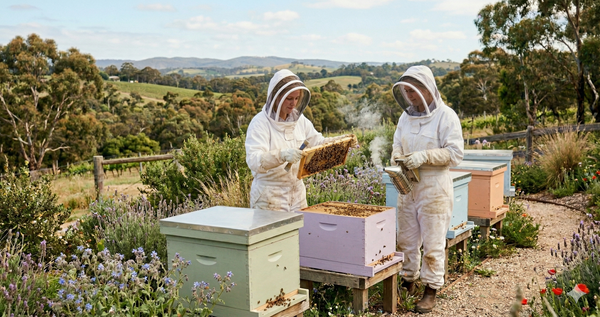
A professional beekeeper managing 500 hives does not check them when they feel like it. They run a schedule. Every hive is inspected at minimum monthly during season, more often during peak mite season. Every inspection includes a mite count using a standardised method, not a guess based on looking at the bees. Every count is recorded. Every treatment is documented with the product used, the date applied, the date removed, and the result.
When a colony is too heavily infested to save, it is culled. Not because the beekeeper wants to lose a hive, but because leaving it alive would turn it into a mite bomb that threatens every other colony on the site. That decision requires training, experience, and a willingness to prioritise the health of the entire operation over sentiment about a single colony.
Professional beekeepers also coordinate. They talk to other operators in their region about treatment timing. They share resistance data. They report unusual mite loads. They participate in industry monitoring programs. This coordination only works when enough beekeepers in a region are operating at the same standard. One unmanaged apiary can undo the work of a dozen managed ones.
The training gap
Australia's commercial beekeeping workforce is ageing and shrinking. Many of the most experienced operators are approaching retirement. The knowledge they carry, decades of understanding local conditions, seasonal patterns, and colony behaviour, walks out with them when they leave. There is no university degree in beekeeping. Most training happens through mentorship and on-the-job experience, which takes years.
Meanwhile, the Varroa management skills that Australian beekeepers need are new. Before June 2022, no Australian beekeeper had ever needed to treat for Varroa. The entire industry is learning on the job, at speed, while the mite spreads and resistance develops. The beekeepers who will hold this system together in five years are the ones being trained right now. If we are not investing in that training pipeline, we are building a workforce gap that will be extremely difficult to close later.
Hobby beekeepers are not filling this gap. They are not trained to fill it. And the expectation that they should, because they love bees and have good intentions, is not a strategy. It is wishful thinking.
The nuance
None of this means hobby beekeeping should be banned. Responsible hobby beekeepers who commit to proper Varroa management, invest in training, keep records, treat on schedule, and coordinate with commercial operators in their area should absolutely keep bees. They contribute to local pollination. They build public awareness. They sometimes become the next generation of professional beekeepers.
But they need to be honest about what they are and what they are not. A hobbyist with three hives in their backyard is not agricultural infrastructure. They are not a substitute for a professionally managed apiary on a working farm. And if they are not treating for Varroa, they are not helping. They are actively making it harder for the people who are.
The save-the-bees narrative, while well-meant, has created a dangerous assumption that more beekeepers equals better outcomes. In a pre-Varroa world, that was roughly true. In a Varroa-positive country, more untreated hives means more mite pressure, more resistance, and faster collapse of the system that agriculture depends on.
The real work ahead
What Australia actually needs is straightforward, even if it is not easy. More commercially managed hives under professional care, placed on working farms where pollination is needed. More young people trained in beekeeping as a career, not just a weekend interest, and supported to build viable businesses. More investment in the monitoring systems, treatment infrastructure, and regional coordination that Varroa management demands.
Every country that has been through this has learned the same lesson. The hobby sector contracts. The professional sector absorbs the workload. And the countries that invested early in professional infrastructure recovered faster and at lower cost than the ones that waited.
Australia still has time to invest early. The Varroa detection was June 2022. Eradication was abandoned in September 2023. Resistance is confirmed and spreading. We are in the window where building professional capacity still works. That window will not stay open forever.
That is what 1000 Hives is building. Not backyard enthusiasm. Professional infrastructure. Managed hives on working farms, funded by sponsors, overseen by qualified beekeepers. Permanent placements with documented monitoring and treatment protocols. The kind of system that can absorb Varroa pressure and keep producing, season after season, while the hobby sector figures out what it wants to be.