1000 Hives · Agriculture & Policy
The $4.6 billion problem nobody is talking about
Crops worth $12.9 billion depend on bee pollination.
The pollination itself is worth $4.6 billion a year.
Varroa is here. The window for action is closing.
Here is a number that should keep agricultural policymakers awake at night. Honey bee pollination contributes $4.6 billion to Australian agriculture every year. The crops that depend on it, to varying degrees, are worth $12.9 billion annually. That is not an abstract figure. It is almonds, apples, avocados, berries, cherries, cucumbers, canola, macadamias, and dozens of other industries that depend on managed pollination to exist at commercial scale.
Around 65% of Australian agricultural production relies on honey bee pollination. Most of that comes from managed hives. Not wild bees. Not native pollinators. Managed European honey bees, looked after by professional beekeepers.
What collapse actually looks like
We do not have to imagine it. New Zealand went through this after Varroa was detected in Auckland in April 2000. Wild honey bee colonies collapsed within a decade. Managed colonies came under sustained pressure. Pollination services became scarce and expensive. The country rebuilt its managed hive network, but at enormous cost and under crisis conditions. Training had to happen fast. Infrastructure had to be built from scratch. New Zealand went from reactive to functional, but it took years and the losses along the way were permanent.
Australia is already seeing the early pricing signals. Almond pollination currently runs $155 to $162 per hive, up significantly over the past decade. As Varroa spreads and hive losses climb, those fees will rise further and availability will tighten. Growers who cannot secure hives simply will not get a crop. In New Zealand, the pastoral sector alone now faces an estimated NZ$230 million in annual losses from reduced clover pollination, which means more reseeding and more synthetic fertiliser to compensate for what bees used to do for free. Australia's pastoral and broadacre sectors face the same trajectory.
Varroa was confirmed at the Port of Newcastle in June 2022. Eradication was abandoned in September 2023. The mite is now established across NSW, Victoria, Queensland, the ACT, and South Australia. The clock is running.
Which industries get hit first
It will not be even. Some crops will suffer immediately. Others will take longer. The ones most exposed are the ones with narrow flowering windows, high hive density requirements, and no alternative pollination pathway.
| Crop | Pollination dependency | Risk level |
|---|---|---|
| Almonds | 100% dependent, six to seven hives per hectare required | Highest risk |
| Apples | Cross-pollination essential for commercial fruit set | Highest risk |
| Avocados | Heavily dependent on managed hive density | Highest risk |
| Cherries | Narrow flowering window, requires high hive availability | Highest risk |
| Canola | Yield improves 20 to 30% with managed pollination | Moderate risk |
| Berries | Partially self-pollinating but yield drops without managed bees | Moderate risk |
| Cucurbits | Require insect transfer between male and female flowers | Moderate risk |
Almonds are the canary. They flower in August and September, a narrow window, and they need intensive pollination at six to seven hives per hectare. Over 200,000 hives are trucked to the Sunraysia and Riverland regions every season just for almonds. If hive availability drops, almond yields collapse within a single season. Growers cannot just plant something else. They have 20-year orchards. When Varroa kills the bees, they watch their land become increasingly unproductive.
The crops least vulnerable are the ones that do not need pollination at all. Grains. Potatoes. Sugar cane. So when pollination capacity drops, the mix of Australian agriculture shifts. We lose diversity. We lose the high-value exports. We are left with low-margin commodity crops that anyone can grow.
The almond industry alone is worth $1.1 billion annually.
Australia is the second-largest almond exporter in the world behind the United States. The entire industry depends on managed honey bee pollination during a six-week window every winter. There is no alternative pollinator that works at this scale. If hive numbers drop, the industry contracts. It is that direct.
The ripple effect
Production drops, supply tightens, prices rise. Fresh fruit and vegetables get more expensive at the supermarket. Farmers who depend on pollination-heavy crops lose income. Some exit agriculture entirely. Regional communities built around horticultural areas feel it immediately. Jobs, services, and local spending all contract.
Export revenue takes a hit. Australia's fruit and nut exports are significant. When supply drops because we cannot pollinate, competitors fill the gap. We lose market share we may never recover. We do not just lose the crops. We lose the customers.
The downstream chain nobody tracks.
Food processing companies that rely on Australian-sourced ingredients have to find alternatives. They offshore sourcing or substitute with imports. It reshapes supply chains and pricing right down to what you pay at the checkout. The beekeeper with the untreated hive never sees that chain. But it is real, and it starts with them.
The cost of waiting
The current approach is to hope. Hope that hobbyists step up. Hope that Varroa does not spread faster than managed colonies can adapt. Hope that someone else solves it.
That is not a strategy. That is a gamble with $4.6 billion in annual agricultural value on the table.
Australia currently has roughly 855,000 registered managed hives. That sounds like a lot until you consider that over 200,000 of those are needed just for almonds during a single six-week window. The rest of the agricultural calendar, from apple blossom in spring through to avocado and macadamia in summer, draws from the same pool. There is no surplus. There is barely enough.
Now add Varroa. Colony losses of 10 to 15% per year are the norm in every country where Varroa is established, even with active management. Apply that to Australia's hive numbers and you are losing 85,000 to 128,000 hives annually. The system has to replace those losses every year just to stand still, before any growth in agricultural demand.
What investment actually returns
Every managed hive working reliably creates multiple dollars of agricultural value. A single apiary servicing almond pollination at current rates of $155 to $162 per hive generates thousands in direct pollination fees, and the crop value it enables is many times that. Scale reliable hive infrastructure across hundreds of farms and you are protecting billions in ongoing productivity.
Then there is the social infrastructure. Trained beekeepers with viable careers. Professional support networks. Disease monitoring systems. Varroa treatment expertise. Research capacity. Those do not disappear when a season ends. They compound. They create careers. They make Australian agriculture more resilient year after year.
The workforce is the bottleneck.
Roughly 2,000 commercial beekeepers manage over 80% of Australia's honey production and most of its pollination services. Many are approaching retirement. Younger beekeepers look at the economics, the lifestyle, and the Varroa complexity, and choose something else. Without a funded pathway into professional beekeeping, the workforce shrinks at exactly the moment it needs to grow.
The moment we are in
We are not in crisis yet. We are in the window where action still works. Varroa is here. Pyrethroid resistance has been confirmed in NSW and Queensland. But managed hives are still viable. Professional beekeeping is still economically viable. Farmers still have options.
Close that window and the cost of recovery jumps exponentially. New Zealand proved that. Keep it open, invest properly, and Australia stays a world-class agricultural producer with the pollination infrastructure to match.
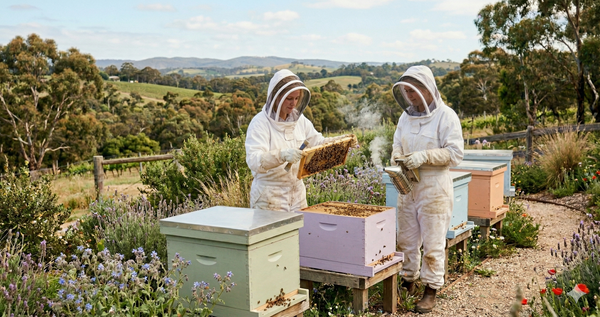
That is what 1000 Hives is building. Permanently managed hives on working farms, maintained by professional beekeepers with Varroa management training, funded by people who understand that the honey is the byproduct and the pollination is the point.