1000 Hives · Biosecurity & Management
No beekeeper, no honey bee. It is that simple.
One colony will collapse under Varroa.
The other can survive it.
The only difference is whether someone is managing it.
The gap between a feral colony and a managed hive is not subtle. It is the difference between a colony that will collapse under Varroa and one that can survive it. That distinction matters now more than ever.
What Varroa actually does to a colony
Varroa destructor is a parasitic mite roughly the size of a pinhead. It attaches to adult bees and breeds inside capped brood cells where larvae are developing. While feeding, it punctures the bee's body and drains fat reserves, weakening the immune system and transmitting viruses including deformed wing virus, acute bee paralysis virus, and others.
A small number of mites in a hive is manageable. The problem is exponential growth. Varroa populations can double every few weeks during brood season. By the time a beekeeper notices visible signs, such as deformed wings, scattered brood pattern, or bees crawling on the ground, the infestation is often already critical.
Left untreated, the colony enters a spiral. Fewer healthy bees emerge. The workforce shrinks. The hive can no longer regulate temperature, defend against robbing, or feed its brood. Within two to three years the colony is dead.
What managed actually means
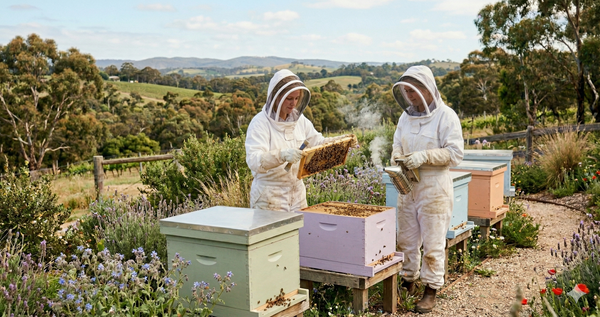
A managed hive is one that gets checked regularly. The beekeeper monitors for Varroa mite loads, applies treatments when needed, manages nutrition, space, and swarming behaviour. They keep records. They coordinate with other beekeepers on biosecurity.
It is not complicated in theory. In practice it requires skill, time, and consistency.
A feral or abandoned colony gets none of this. No monitoring. No treatment. No intervention.
On its own
No monitoring. No treatment. No biosecurity. When Varroa arrives, the colony collapses in two to three years. There is no path to survival without human intervention.
Under professional care
Regular inspections. Documented mite counts. Treatment protocols. Biosecurity standards. The colony has a fighting chance because someone is paying attention and knows what to do.
Why feral colonies cannot survive Varroa
People often assume feral colonies are tougher. That they will adapt. That natural selection will produce Varroa-resistant populations over time.
That is not how this works.
Varroa kills colonies too fast for adaptation to matter. A feral hive infested with Varroa does not gradually decline over generations. It collapses within two to three years. There is no time for natural selection. There is no refuge. There is no way for resistant traits to accumulate in a population that is dying faster than it can reproduce.
The only colonies that survive Varroa pressure are the ones that get treated. This is not a theory. It is the documented outcome from every country where Varroa has established.
| Feral colony | Managed hive | |
|---|---|---|
| Varroa monitoring | None | Regular mite counts on schedule |
| Treatment | None | Chemical, mechanical, or biological rotation |
| Biosecurity | None | Controlled sourcing, no shared equipment |
| Survival under Varroa | 0% within 2-3 years | 90%+ with consistent management |
| Pollination reliability | Unpredictable, declining | Consistent, year after year |
| Record keeping | None | Documented hive history and health data |
Three pillars of managed hive survival
Monitoring
Regular hive checks catch Varroa early, before mite loads reach critical levels. You cannot treat what you do not detect. Documented mite counts are what separate guesswork from management.
Treatment
Once Varroa is identified, the beekeeper applies chemical, mechanical, or biological treatments on a rotation schedule. Resistance is emerging, but there are options when you know your mite load and can respond in time.
Biosecurity
Managed beekeepers source colonies carefully, avoid sharing equipment with untreated apiaries, and reduce the risk of introducing or spreading Varroa within their operation.
A feral colony has none of these defences. That is not a character flaw. It is just the reality of being unmanaged in a Varroa-positive environment.
Backyard beekeeping is not enough
There is a strong and growing movement of backyard and hobby beekeepers across Australia. They care deeply about bees. They are learning. Some of them manage their hives very well.
But hobby beekeeping, even done responsibly, does not scale to replace the pollination services that wild colonies provided or that agriculture actually needs.
The numbers do not add up without professional scale.
A backyard beekeeper might manage 5 to 10 hives. A commercial operation manages hundreds or thousands. If Australia is going to maintain pollination services as wild colonies collapse, it needs professional-scale hive networks. That is not a criticism of hobby beekeeping. It is the reality of what the problem requires.
The 1000 Hives model
Instead of relying on backyard beekeepers or hoping feral colonies adapt, 1000 Hives is building a network of permanently managed hives on working farms across Australia. Each hive gets professional monitoring and treatment. Each location is biosecure. Each hive is a productive asset for the farm and a reliable pollination source for the surrounding region.
It is not glamorous. It is not a hobby. It is infrastructure.
On-farm placement means the hives are producing pollination services exactly where they are needed most. Not trucked in for a season and removed. Embedded, accountable, and there for the long term.
What this costs when it goes wrong
New Zealand provides the clearest picture of what happens when feral colonies collapse and managed hive supply does not keep up with demand.
After Varroa arrived in 2000, pollination service fees nearly doubled within a decade, rising from around NZ$80 per hive to NZ$150. In some regions and for some crops, fees have since climbed to NZ$200 or more per hive. The pastoral sector alone faces an estimated NZ$230 million in annual losses from reduced clover pollination, which means more reseeding and more synthetic fertiliser to compensate.
For Australia, the projections are similar or worse. We have a larger agricultural sector, greater geographic spread, and will face more competition for a shrinking pool of managed hives. Feral colony populations are expected to decline 95 to 100% within three years of Varroa establishing in an area. Every hive that disappears from the wild is one more that needs to be replaced with a managed alternative, or the pollination gap widens.
Higher pollination costs flow straight to consumers.
When it costs more to pollinate almonds, avocados, and apples, those costs land on the shelf price. Farmers absorb what they can and pass on the rest. In regions where pollination supply drops below what crops need, yields fall and imports fill the gap at higher prices.
The hard truth
Varroa is not going away. Feral colonies will collapse. Eradication is off the table. The only option remaining is building a managed hive network robust enough to replace the pollination services we are about to lose from the wild population.
We still have time, but not much.
The question is whether we build the infrastructure ahead of the collapse, while it is still possible to do it efficiently, or whether we scramble to rebuild after the damage is already done at five to ten times the cost.