1000 Hives · Food & Agriculture
65% of Australian agriculture depends on pollination
Two thirds of what fills supermarket shelves
exists because a pollinator did its job.
That is not a metaphor. It is a $12.9 billion fact.
Most people know bees are important. Very few understand the actual scale of what that means. Not in a feel-good conservation sense. In a hard economic, food-on-the-table sense.
65% of agricultural production in Australia depends on insect pollination, and honey bees are by far the most significant commercial pollinator delivering that service. That is not a rounded-up talking point. That is the number.
How pollination actually works
When a bee visits a flower it is after one thing. Nectar. But in the process of moving from flower to flower it picks up pollen on its body and transfers it. That transfer is pollination. That pollination is what allows a flower to develop into a fruit, a nut, a vegetable.
Without it the flower drops. No fruit forms. No harvest happens. No product reaches the shelf.
Honey bees are uniquely effective at this because of how they forage. They are faithful to a single plant species per foraging trip, which means pollen goes from almond blossom to almond blossom, from apple flower to apple flower. That specificity is what makes them so valuable commercially. Other insects pollinate opportunistically. Honey bees pollinate at scale, reliably, season after season.
The numbers behind your food
We are talking about 35 different agricultural industries that rely on bees. From major export crops like almonds and macadamias to everyday staples like apples, cucumbers, and pumpkins. This is not niche economic activity. This is foundational infrastructure for how Australia feeds itself and earns export income.
The $4.6 billion figure is often quoted but it is actually conservative. It measures the direct pollination service value. The full downstream value, including processing, packaging, retail, export, and jobs in regional communities, is many times larger.
How reliant are key crops on pollination
Not every crop is equally dependent. Some cannot produce a single fruit without a pollinator visit. Others benefit enormously but can manage partial yields on their own. Here is where Australia's key crops sit.
| Crop | Why pollination is essential | Dependency |
|---|---|---|
| Almonds | Cannot self-pollinate. Every almond requires a bee visit. No bees means no almonds. | 100% reliant |
| Pumpkins | Male and female flowers on the same plant, but insects must move the pollen between them. | 100% reliant |
| Apples | Most commercial varieties are self-incompatible and need cross-pollination to set fruit. | Essential |
| Cherries | Most sweet cherry varieties are self-sterile. Timing and hive density during the narrow flowering window are critical. | Essential |
| Avocados | Around 90% of commercial fruit set depends on insect pollination. Yields collapse without it. | 90%+ reliant |
| Macadamias | 80 to 100% of fruit comes from cross-pollination. Most cultivars are self-incompatible. | 80-100% reliant |
| Blueberries | Varies by variety. Some can partially self-pollinate but produce smaller, lighter fruit without bees. | Highly reliant |
| Cucumbers | Field cucumbers need bee pollination. Greenhouse varieties can fruit without it. | Highly reliant |
Pull any of these crops out and a hole opens in the food system. Pull out several and you have a supply crisis that hits consumers through price rises and import dependency.
Wild bees vs managed hives
Australia has historically relied on a combination of managed hives and wild or feral bee colonies to deliver its pollination needs. Farmers with managed hives on their properties got reliable, consistent pollination. Those without still benefited from wild colonies in nearby bush, hedges, and tree hollows foraging across their land.
That system worked because wild colonies were abundant and free. They supplemented managed pollination without anyone having to pay for them.
Varroa changes that calculation completely.
Wild and feral honey bee colonies cannot survive Varroa without treatment. They will collapse within two to three years of infestation. As wild populations disappear, the supplementary pollination they provided disappears with them. The only reliable source of pollination will be professionally managed hives placed deliberately on or near farms.
When pollination declines
We do not have to speculate. We can look at regions where bee populations have declined and map what followed.
Fruit set drops first. Yields fall. Farmers have less to sell. Some crops become uneconomical at reduced yields and growers walk away from them entirely. Land use changes. Regional economies built around those crops contract. Jobs in packing sheds, transport, processing, and retail all follow the same downward curve.
At the export level, buyers in Japan, China, the Middle East, and the UK who rely on Australian almonds, avocados, and macadamias start looking for alternative suppliers when Australian supply becomes inconsistent. Once those relationships move, rebuilding them takes years.
The damage does not happen overnight.
It happens gradually across seasons. Which is both reassuring and dangerous. Reassuring because we still have time to act. Dangerous because the gradual nature of it makes it easy to underestimate until the tipping point has already passed.
Australia's window to act
Australia's advantage has always been that we came to Varroa late. While the rest of the world spent decades rebuilding pollination infrastructure after wild colony collapse, Australia still had both managed and wild bees working together. That gave us a buffer. A window.
That window is closing. Varroa is established across multiple states. The wild colony collapse that other countries experienced is now our near-term future.
What we can do is build a robust network of professionally managed hives, positioned on working farms, before the gap between pollination supply and agricultural demand becomes a crisis rather than a warning.
This is a food security issue
Food security means having reliable access to sufficient, safe, nutritious food. Australia prides itself on being a food-secure nation and a significant food exporter. Both of those things depend on maintaining the agricultural productivity that bees underpin.
A decline in pollination capacity does not just affect farmers. It affects what Australians can afford to eat, what regional communities can sustain, and what the country can offer global food markets. These are national-level consequences flowing from the health of a single insect species.
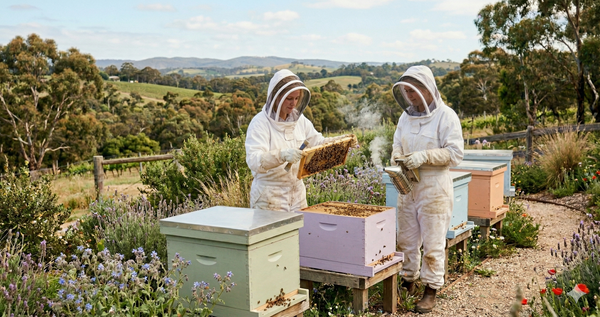
That is why 1000 Hives exists. Not as a feel-good conservation project but as a practical response to a real infrastructure problem. Permanently managed hives on working farms, funded by people who understand what is at stake, are the most direct way to protect the pollination services Australian food production depends on.